Mental Alchemy: The Art of Inner Transformation
Adrian Schmidt
Cosmology Expert
Ideas for self-reflection – not a substitute for advice from a doctor or therapist.
What Is Mental Alchemy?
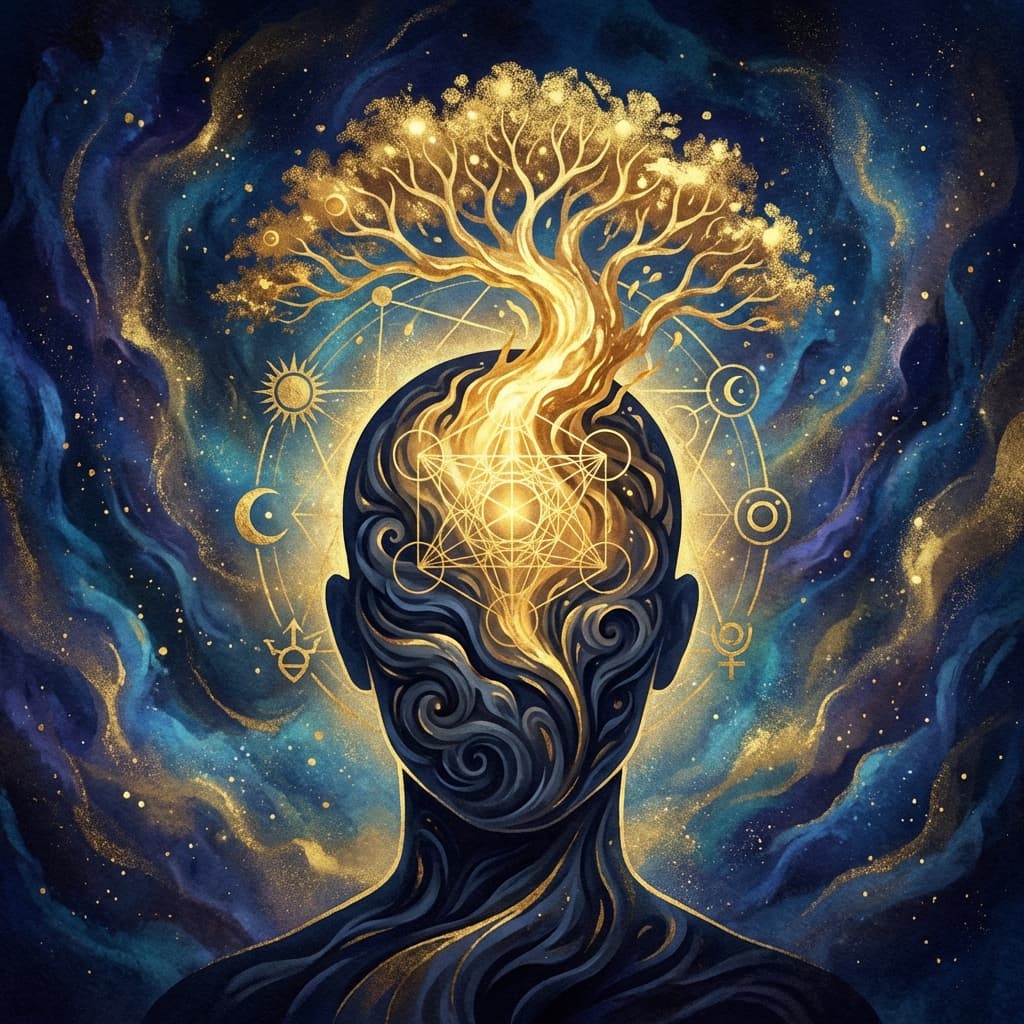
Mental alchemy is the art of consciously transforming inner states. The alchemists of the Middle Ages tried to turn lead into gold, but even for them the Great Work was also an image for the refinement of the human being. Mental alchemy takes up this image and works with a different material: one's own consciousness.
Its basic idea comes from Hermeticism, more precisely from the principle of polarity: opposites are, accordingly, only different degrees of the same thing. Fear and courage, anger and calm, sadness and joy lie on one scale, and whoever knows the pole can change direction.
Where the Idea Comes From
The notion of mental transmutation was shaped above all by the Kybalion, a book published in 1908 under the name "Three Initiates". It sums up the Hermetic tradition in seven principles, which the article on the seven Hermetic laws presents. The Kybalion presents itself as ancient teaching but is a text of the early 20th century that reinterprets older Hermetic writings. One sentence from it describes mental alchemy like this:
"Mind (as well as metals and elements) may be transmuted, from state to state; degree to degree; condition to condition; pole to pole; vibration to vibration."
Classical alchemy describes change in stages: the blackening (nigredo), in which the old falls apart, the whitening (albedo), in which what remains becomes clear, and the reddening (rubedo), in which the new takes shape. The stages are in the library; how UmbraLux understands these images is shown on the page Inner Alchemy.
The Four Steps of Transmutation
- Recognize the state: name what you feel without fighting it.
- Find the opposite pole: what would be the opposite of this state, and how would you recognize it?
- Direct your attention: focus on memories, images or thoughts that carry the state you want.
- Notice the change: let the new perspective shape your experience and observe what shifts.
Practical Exercise: The 3-Minute Transmutation
- Minute 1: breathe calmly and acknowledge the state: "Right now I feel fear, anger or sadness."
- Minute 2: remember a moment when you felt the opposite and imagine it as vividly as you can.
- Minute 3: tell yourself inwardly: "I'm now turning toward courage, calm or joy." Feel what changes in you.
Why It Can Work
This isn't magic but directed attention, wrapped in the image of alchemy. Anyone who first acknowledges a state and then deliberately takes another perspective often experiences the same situation differently. Psychology knows a related principle: reappraising a situation, a well-studied way of dealing with emotions. Mental alchemy gives this principle a language and an image that are easier to remember.
The Limits of Mental Alchemy
Mental alchemy doesn't mean pushing unpleasant feelings away or papering over them with "positive thinking". The alchemists knew: no transformation without blackening. Feelings first want to be noticed; only then can they be transformed. What can't be transformed belongs more to shadow work, which accepts repressed parts instead of reversing them. And anyone who is dominated by fear or low mood for a long time will find better support in medical or psychotherapeutic care.
Mental Alchemy in Everyday Life
The practice is most useful when it becomes a habit: a minute in the morning to name your mood, a moment in an argument before you answer, a short look in the evening at what has changed. How the Hermetic principles can look in everyday life is described in the article on Hermetic principles in everyday life. In UmbraLux you can talk with Verus, your AI companion, about what comes up; he knows your profile.
Frequently Asked Questions about Mental Alchemy
What is mental alchemy?
The practice of consciously noticing inner states and transforming them into their opposite pole, after the image of the alchemists and the Hermetic principle of polarity.
What is the difference between mental and inner alchemy?
Inner alchemy is the broader term for inner change in the image of alchemy, in the West as in the Taoist tradition. Mental alchemy means the part of it that works with thoughts and attention.
Is mental alchemy the same as positive thinking?
No. Positive thinking often skips the unpleasant state. Mental alchemy begins by acknowledging it and only then transforms it.
How often should I do the exercise?
Regularly and briefly works better than rarely and at length. Three minutes a day are enough to notice whether the method helps you.
Related Articles
Marcus Aurelius: Stoic Self-Mastery as a Path to Yourself
For Marcus Aurelius, self-mastery means clarity of judgment, not suppression. What his Meditations teach, with four Stoic exercises for your everyday life.
Read more WisdomNietzsche and Self-Overcoming: What the Overman Teaches
Friedrich Nietzsche described self-overcoming as the highest human task. What his philosophy says about personality growth, the will to power and the overman.
Read more WisdomAristotle: Eudaimonia, Virtue and the Art of Living Well
Aristotle taught eudaimonia — human flourishing through virtue, reason and community. His ethics are surprisingly modern and deeply interwoven with personality development.
Read more