The 7 Hermetic Laws: What They Mean and How to Live Them Day to Day
Adrian Schmidt
Cosmology Expert
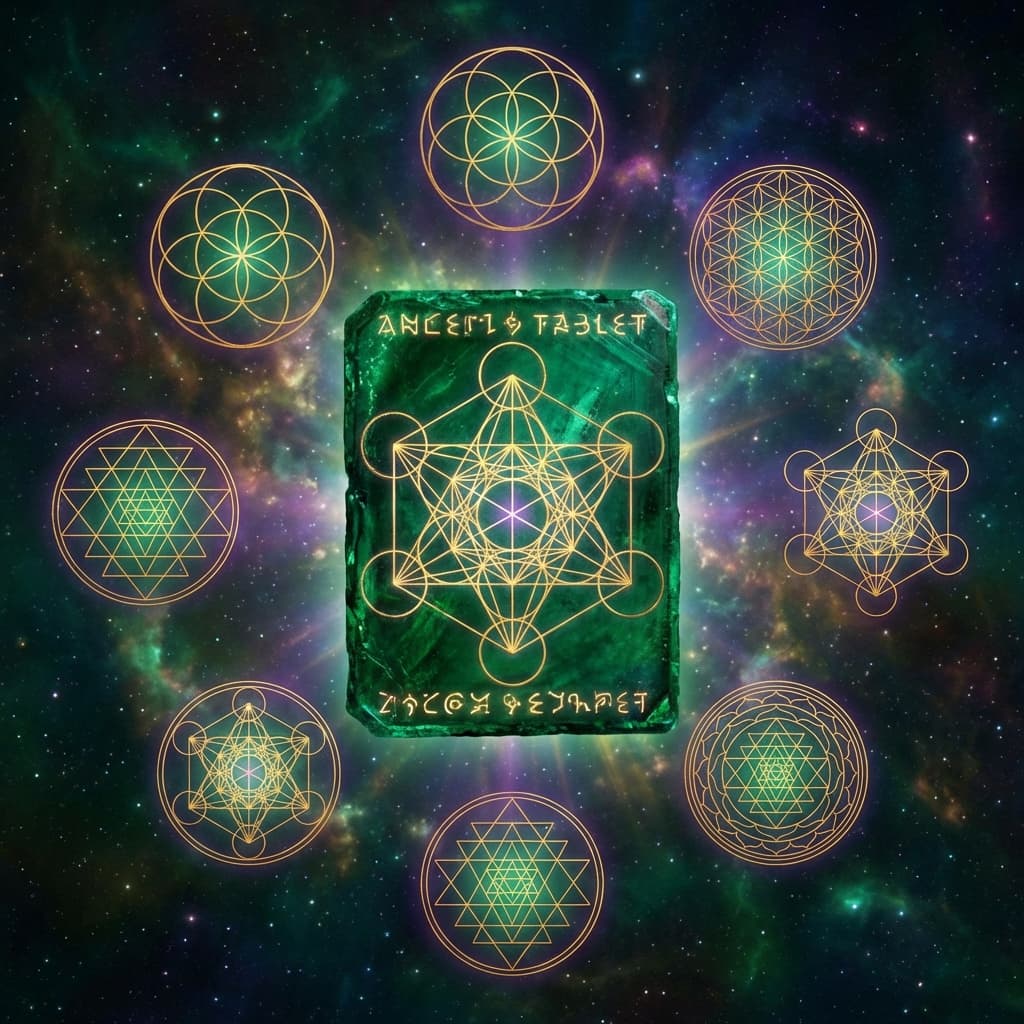
The seven Hermetic laws, also called the Hermetic principles, are a classic of Western esotericism. Many people know “As above, so below” without knowing where the phrase comes from. The principles describe how, according to Hermetic teaching, mind and world are connected, and they can be used as thinking tools in everyday life.
This article explains where the seven laws come from, what each one says and how you can apply it in concrete terms, without reading more into them than they can bear.
Where the Seven Principles Come From
In this form, the seven principles appear in The Kybalion, a book published in Chicago in 1908 under the pseudonym “Three Initiates”. It invokes Hermes Trismegistus, the “thrice-greatest Hermes” to whom tradition attributes the Hermetic writings, and presents itself as the transmission of an ancient teaching. The older Hermetic texts, however, such as the Greek writings of the Corpus Hermeticum or the Emerald Tablet, to which “As above, so below” goes back, contain no such list. The author of The Kybalion is usually thought to be the American writer William Walker Atkinson, who was close to the New Thought movement.
So the seven laws are a modern summary of Hermetic ideas, not a word-for-word tradition from ancient Egypt. The UmbraLux Hermeticism library gives an overview of Hermeticism with all seven principles.
1. The Principle of Mentalism
The Kybalion puts it like this: “The All is Mind; the Universe is Mental.” Everything that exists is seen as the expression of an all-encompassing mind. Mentalism is the foundation of the other six principles.
In everyday life: for one day, observe which thoughts come up when you think about money, relationships or work. Are they thoughts of possibility or of lack? Your inner images shape what you perceive and how you act. They can't guarantee anything, but they set the direction.
2. The Principle of Correspondence
“As above, so below; as below, so above.” According to Hermetic teaching, there is a correspondence between the planes of being, the physical, the mental and the spiritual: patterns repeat in the large and in the small. The phrase is often extended with “as within, so without”.
In everyday life: when someone irritates you in particular, ask yourself: which of this person's traits do I know from myself? Using the outside world as a mirror is also at the core of working with shadow projections. And when a big problem seems unsolvable, look for the same pattern in a small everyday situation and solve it there first.
3. The Principle of Vibration
“Nothing rests; everything moves; everything vibrates.” According to The Kybalion, matter, energy and mind differ mainly in their vibration. Moods, too, are not fixed quantities here but states in motion. The UmbraLux library lists this law as the Principle of Frequency.
In everyday life: you can influence your state instead of being at its mercy: through movement, music, conscious breathing or a deliberate change of thought. A walk often changes more than an hour of brooding.
4. The Principle of Polarity
“Everything is Dual; everything has poles; everything has its pair of opposites.” According to The Kybalion, opposites are identical in nature and differ only in degree: heat and cold are degrees of the same temperature, courage and fear poles of the same axis.
In everyday life: when you feel fear, don't fight it head-on. Look for a thought that is a little braver and that you can still believe, and move on from there. The Kybalion calls this shift along the axis mental transmutation; the article Mental Alchemy describes what the exercise can look like today.
5. The Principle of Rhythm
“Everything flows, out and in; everything has its tides; all things rise and fall.” Ebb and flow, day and night, growth and decay: The Kybalion sees a pendulum swing in everything, one that, after swinging one way, swings just as far the other.
In everyday life: low phases aren't failures but part of the rhythm. Use them for rest, reflection and inner work instead of fighting them, and plan your most ambitious undertakings for the times when your energy rises. If you want to get to know your own daily rhythm, the article on the chronotype is a good place to start.
6. The Principle of Cause and Effect
“Every Cause has its Effect; every Effect has its Cause.” For The Kybalion, chance is merely a name for a law that has not yet been recognized. If you understand causes, you don't have to simply endure effects; you can set causes yourself.
In everyday life: instead of asking “Why is this happening to me?”, ask: “What part did I play in it, and what can I set in motion differently now?” This isn't self-blame, because not everything that happens to you is your doing. It is the search for the part that is in your hands.
7. The Principle of Gender
“Gender is in everything; everything has its Masculine and Feminine Principles.” This doesn't mean biological sex but two creative forces: a giving, active one and a receiving, generating one. According to this teaching, the new arises from their interplay, much like yin and yang in Chinese philosophy. The UmbraLux library describes it as the Principle of Focus, a balance of action and receptivity.
In everyday life: if you're stuck on a project, check what is missing: more structure and action, or more openness, listening and room for something to develop? The same applies in relationships, to the balance of giving and receiving.
What the Laws Are Not
The Hermetic principles are a philosophical and esoteric interpretation of the world, not laws of nature in the sense of physics, and there is no evidence for the often-claimed link to quantum physics. Their value lies elsewhere: they invite you to recognize patterns, to see opposites as a scale and to take responsibility for the part you can influence.
In the UmbraLux library, each of the seven principles has its own entry with its essence and an exercise for practice. Verus, your AI companion in the app, knows your profile and can talk through with you where a principle such as rhythm or polarity is showing up in your life right now.
Frequently Asked Questions about the Hermetic Laws
What are the seven Hermetic laws?
The principles of mentalism, correspondence, vibration, polarity, rhythm, cause and effect, and gender. In this form they come from The Kybalion of 1908 and, according to Hermetic teaching, describe how mind and world are connected.
Do the Hermetic laws come from ancient Egypt?
The Kybalion invokes Hermes Trismegistus and an ancient tradition. But the list of seven principles first appears in this book; the older Hermetic writings contain individual ideas such as “As above, so below”, but no such system.
What does “As above, so below” mean?
That the same patterns show up on every level, in the large and in the small, in the cosmos and in the individual person. In everyday life this means: what you encounter outside can show you something about your inner life.
Is Hermeticism a religion?
Not in the sense of a church with a creed. The ancient Hermetic writings combine philosophy and piety; you can use the seven principles of The Kybalion as food for thought regardless of your faith.
How do I start applying the laws in everyday life?
Take one principle per week. With rhythm, for example, observe your high and low phases, or with polarity, notice between which poles your moods swing, and in the evening write down what you noticed.
Related Articles
Marcus Aurelius: Stoic Self-Mastery as a Path to Yourself
For Marcus Aurelius, self-mastery means clarity of judgment, not suppression. What his Meditations teach, with four Stoic exercises for your everyday life.
Read more WisdomNietzsche and Self-Overcoming: What the Overman Teaches
Friedrich Nietzsche described self-overcoming as the highest human task. What his philosophy says about personality growth, the will to power and the overman.
Read more WisdomAristotle: Eudaimonia, Virtue and the Art of Living Well
Aristotle taught eudaimonia — human flourishing through virtue, reason and community. His ethics are surprisingly modern and deeply interwoven with personality development.
Read more